Here's when those matter, when they don't, and what most comparisons get wrong.
The H200 has 76% more memory and 43% more bandwidth than the H100, but identical peak compute throughput, identical NVLink speed, and identical power draw. If your workload is memory-bound — large LLM inference, long context windows, big batch sizes — the H200 delivers 30–90% higher throughput. If your workload fits comfortably in 80 GB and isn't bandwidth-constrained, the H100 is the better value most of the time.
That's the entire decision. Most other comparisons overstate the difference in one direction or the other; the spec sheet is unambiguous.
Before going further: there is significant misinformation circulating about these GPUs, including in AI-generated search summaries. A common error is claiming that the H200 has higher FP8 compute than the H100 (e.g., ~4,800 TFLOPS vs ~3,958 TFLOPS) or that it operates at dramatically higher NVLink bandwidth levels (e.g., ~1.8 TB/s). These figures are incorrect for both H100 and H200, which share the same Hopper-class compute architecture and NVLink generation. The higher compute and interconnect figures are instead associated with NVIDIA’s newer Blackwell-generation GPUs, such as the B200, but even there, exact numbers depend on configuration and are often misrepresented in secondary sources.
Per NVIDIA's official H200 datasheet and corroborated by Spheron, RunPod, and MLPerf benchmark results: all peak compute specifications on the H200 SXM are identical to the H100 SXM. Same GH100 die, same fourth-generation Tensor Cores, same FP8 Transformer Engine, same NVLink 4.0 at 900 GB/s. The H200 is a memory upgrade, not a compute upgrade.
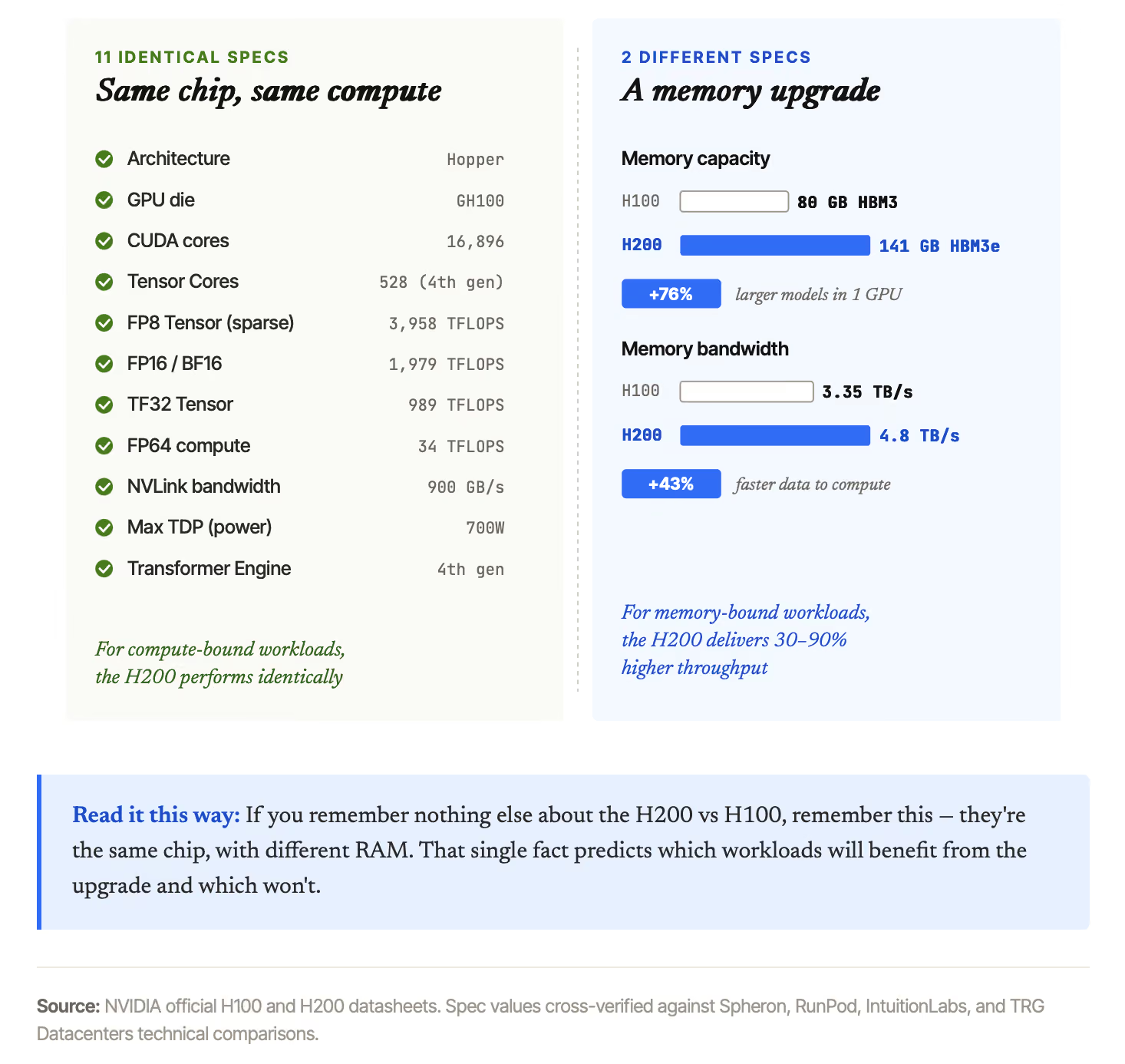
Everything that determines how fast the GPU can calculate is identical between the H100 and H200. Same Tensor Cores, same FP8 throughput, same Transformer Engine, same multi-GPU networking via NVLink 4.0.
This means: for compute-bound workloads, the H200 is not faster than the H100. Running a small model that fits in 20 GB? The H200 won't help. Doing HPC simulation that's pinned on FP64 arithmetic? Identical performance. Fine-tuning a 7B model? Near-identical.
The H100 and H200 also share the same software stack (CUDA, cuDNN, TensorRT, Transformer Engine), the same power envelope, and the same multi-instance partitioning. Code that runs on one runs on the other without modification. Cluster designs that use one work for the other. The H200 isn't a new chip — it's the same chip with a memory subsystem upgrade.
Two things changed, and both relate to memory.
Memory capacity: 80 GB → 141 GB (+76%). This is the headline. It allows significantly larger models and KV caches to fit on a single GPU. A 70B-parameter model in BF16 requires ~140 GB for weights alone, not including KV cache or runtime overhead, meaning it is effectively at the upper limit of the H200 in real inference scenarios and not feasible on the H100 without sharding.
With FP8/BF16 mixed precision or quantization, 70B-class models can run on both GPUs, but the H200 provides additional headroom for larger batch sizes and longer context windows. Larger models in the 100B+ range still generally require model parallelism or quantization even on H200.

Memory bandwidth: 3.35 → 4.8 TB/s (+43%). This is the workhorse change. Most LLM inference is memory-bound rather than compute-bound: the GPU sits idle waiting for weights and KV cache data to flow from HBM to the Tensor Cores. Faster HBM3e memory means less waiting. In practice, this translates to 15–60% higher inference throughput on memory-bound workloads — even though raw compute is unchanged.
Larger KV cache headroom. When serving a model with long context (32K, 128K tokens), the KV cache — which stores attention activations for every prior token — grows linearly with context length. On the H100, long-context inference quickly exhausts memory; on the H200, it fits with even some possible room to spare. This is the single biggest practical reason teams upgrade from H100 to H200 for production inference.
The spec sheet says memory is the only thing that changed, but how much does that actually matter for real workloads? Here's what independent benchmarks consistently show:
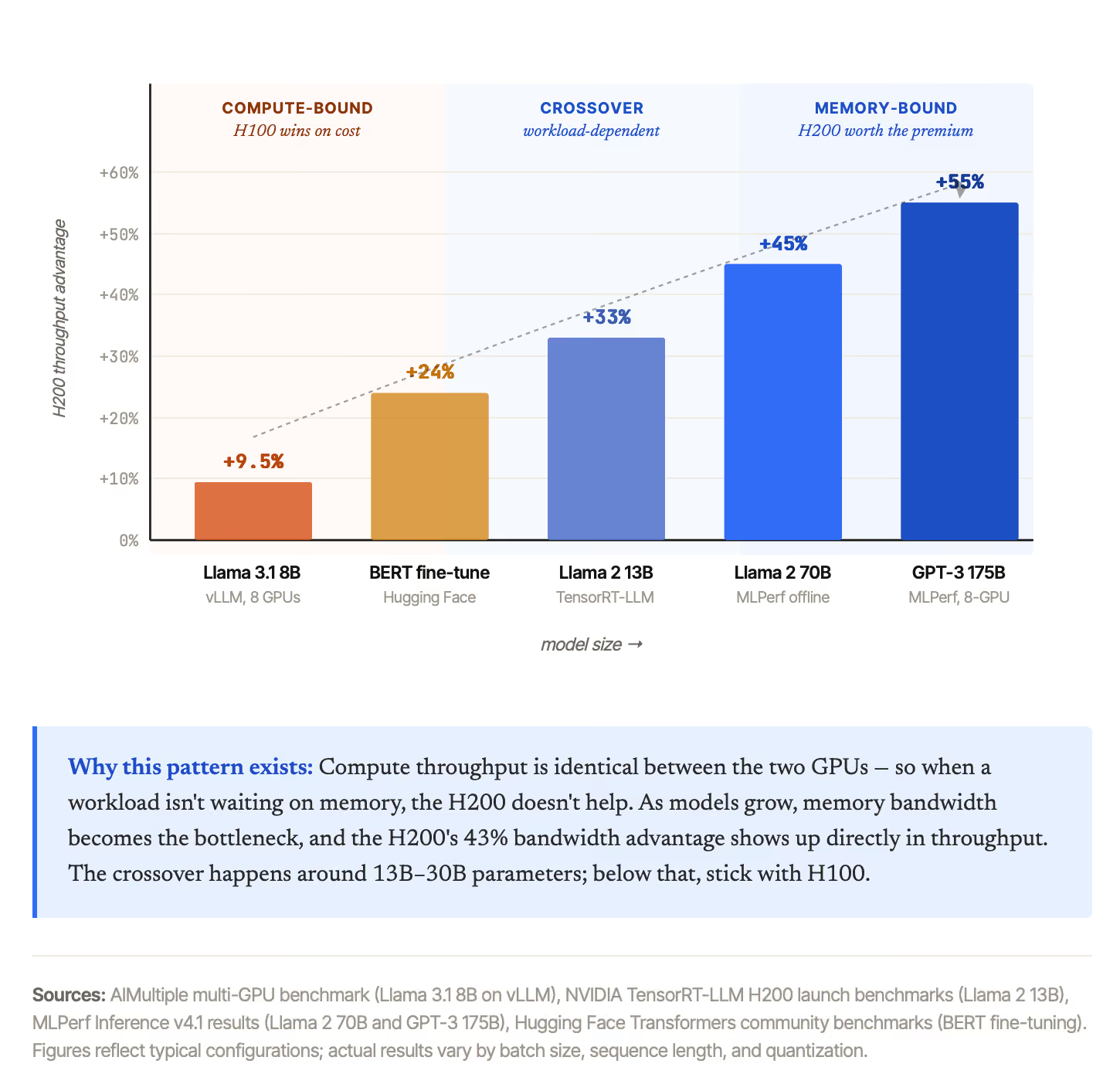
The pattern is clear and consistent across sources: the larger and more memory-bound the model, the bigger the H200 advantage. For small models that fit in a fraction of available memory, the H200 delivers almost no gain over the H100. For 70B+ models with realistic batch sizes, the H200 wins by 25–60%. NVIDIA's official marketing claim of "up to 1.9× inference performance" reflects the upper end of this range — true for specific benchmarks, but not a universal multiplier.
The ~9–10% gain observed on Llama 3.1 8B is illustrative of how the H200 behaves on smaller models. An 8B model requires roughly ~16 GB for weights in FP16, not including KV cache and runtime overhead, so it is not primarily constrained by model weight capacity on either GPU. In this regime, both GPUs are largely compute-bound, with limited sensitivity to memory bandwidth. As a result, the H200’s primary advantage — higher memory bandwidth — produces only modest gains, consistent with expectations from the spec sheet.
The H200 commands a 15–40% premium over the H100, but the gap narrows significantly when you account for what each GPU actually delivers.
Hardware purchase prices (May 2026):
Cloud rental rates (single-GPU, on-demand):
For most workloads, the H200’s ~30% price premium is justified when it delivers meaningful throughput gains or reduces the need for multi-GPU sharding. On large LLM inference workloads (e.g., 70B-class models with realistic batch sizes), the H200 can deliver roughly 25–60% higher throughput depending on configuration, which often translates into lower cost per million tokens despite the higher hourly rate.
For smaller models such as 13B-class workloads that fit comfortably on either GPU, the H100 typically remains more cost-efficient on a TCO basis, though results can vary with batching and utilization efficiency.
This is why the question “is the H200 worth it?” has no universal answer — and why mixed GPU fleets benefit from workload-aware routing rather than standardizing on a single GPU type.
The right way to choose between H100 and H200 is to ask three questions in order:
If yes, the H100 is probably the right choice. The H200's larger memory pool only matters when you're using it.
If not, the H200 lets you avoid multi-GPU sharding and the associated complexity. A 70B-class model in BF16 requires ~140 GB for weights alone, excluding KV cache and runtime overhead, making it impractical on a single H100 and typically requiring multi-GPU tensor parallelism. — which means inter-GPU communication overhead, more complex deployment, and roughly double the GPU cost.
LLM inference at meaningful batch sizes (30B+) almost always is. The bandwidth utilization meter on the GPU spends most of its time near 100%; the compute utilization meter sits at 30–50%. If that's your profile, the H200's ~43% bandwidth advantage translates directly to throughput.
If your workload is compute-bound (small models, FP64 scientific computing, training small networks with high arithmetic intensity), bandwidth doesn't help — and the H200 doesn't either.
For inference workloads with long context (32K+ tokens), KV cache pressure becomes the limiting factor. The H100's 80 GB fills quickly; the H200's 141 GB provides meaningful headroom for production serving of long-context models, especially with high concurrency.
For short-context workloads (≤4K tokens), KV cache pressure is less significant, though still present.
A useful heuristic is that large-model inference (e.g., 70B-class) with full-precision or memory-intensive configurations often benefits from the H200, while smaller or compute-bound workloads are typically better served by the H100.
Training workloads generally benefit less from the H200's memory advantages because gradient checkpointing and tensor parallelism mitigate memory pressure. Mid-size model inference is typically well-served by the H100, while long-context, high-concurrency inference of frontier-class models is where the H200 most clearly justifies its premium.
A practical complication: most production AI teams end up running across multiple clouds — different providers offer different H100/H200 availability, different pricing, and different regional coverage. AWS may have H100 P5 capacity in us-east-1 but no H200; Lambda Labs may have H200 reservations available cheaper than AWS's H100.
Compliance and data residency add further constraints. The result is fragmented operations: separate consoles per provider, inconsistent CUDA images, isolated cost views, and varied governance models across what should be a unified GPU fleet.
Multi-cloud control planes like emma have emerged to consolidate this — a single provisioning flow across AWS, GCP, Azure, and EU-native providers, with pre-validated CUDA images so each VM doesn't begin with a half-day of driver debugging. Whether you adopt a platform layer or build the orchestration in-house, GPU fleet management across mixed H100/H200 (and increasingly B200) inventory is a real operational line item.
This comparison would be incomplete without addressing the elephant in the data center: NVIDIA's B200 (Blackwell) is shipping in volume, and the B300 began deployment in early 2026.
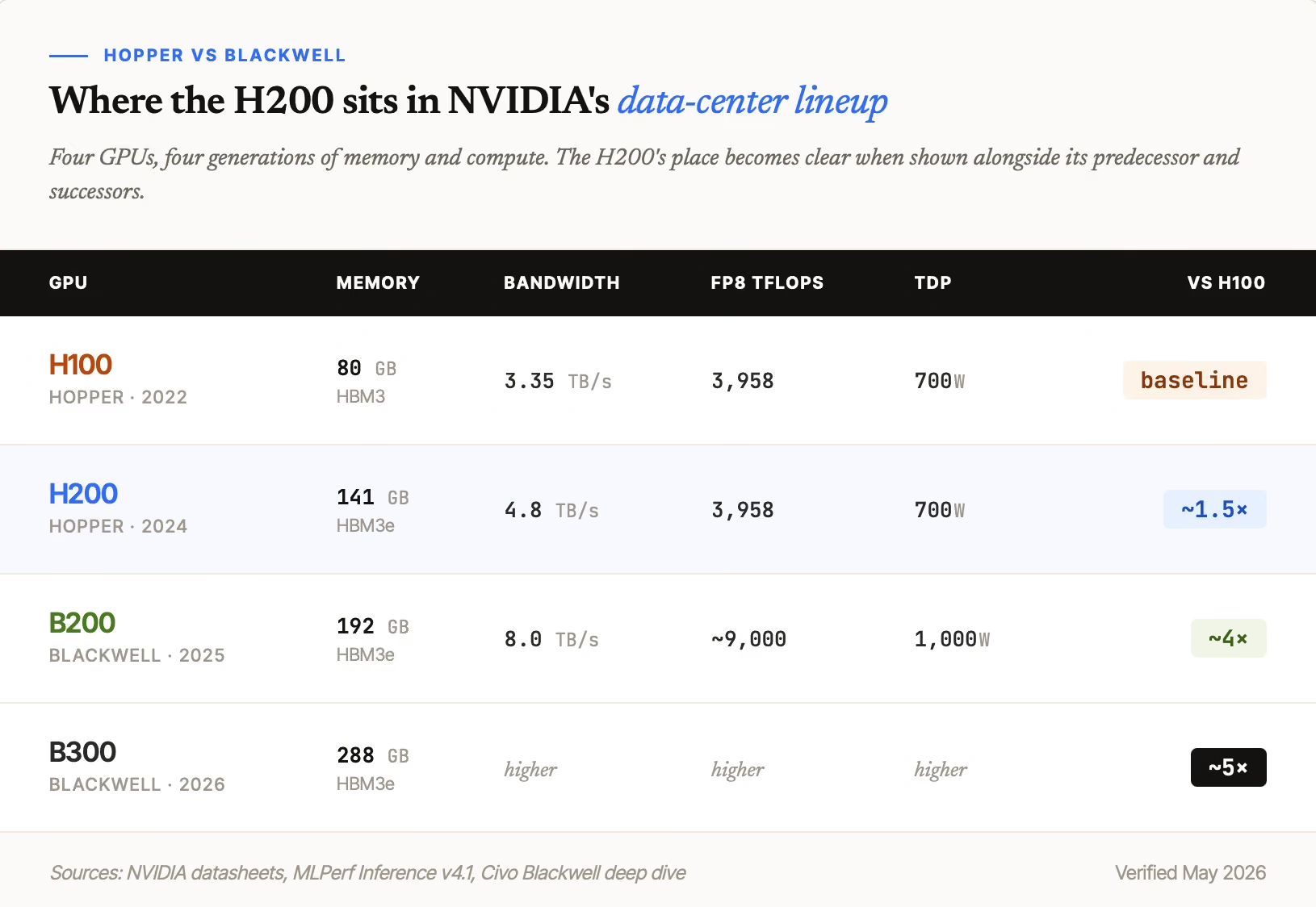
The B200 is genuinely faster than the H100/H200 (the H200 vs B200 ratio is roughly what the AI search comparisons we've seen sometimes incorrectly attribute to H100 vs H200). But B200 deployment often requires liquid cooling, draws 1,000W per GPU, costs 2–3× as much as H100, and currently has less mature software tooling than the Hopper generation.
For most production workloads in 2026, the H100 remains the cost-performance sweet spot, the H200 is the right choice for memory-bound large-model inference, and the B200 is for teams pushing the frontier. The H100 will likely remain economically optimal through at least mid-2027.
The H200 has 76% more memory (141 GB HBM3e vs 80 GB HBM3) and 43% more memory bandwidth (4.8 TB/s vs 3.35 TB/s) than the H100. Peak compute throughput, Tensor Cores, NVLink bandwidth, power draw, and software stack are the same, as both GPUs are based on the Hopper GH100 architecture. The H200 is effectively an H100 with a significantly upgraded memory subsystem, which improves performance for memory-bound workloads.
Primarily for memory-bound workloads. For LLM inference of large models (70B+ parameters) the H200 delivers 30–90% higher throughput depending on batching, context length, and system configuration.. For compute-bound workloads (HPC, FP64 simulation, small models that fit comfortably in 80 GB), the H200 performs essentially identically to the H100. Raw compute TFLOPS are unchanged.
The H200 commands a 15–40% price premium. A single H100 SXM5 costs $25,000–$40,000 to buy outright; the H200 SXM5 runs $30,000–$40,000. Cloud rental: H100 typically $2.2–$3.5/hr, H200 typically $3.00–$7.00/hr. The H200's premium is justified only when its larger memory or higher bandwidth meaningfully changes throughput for your workload.
The H200 is the better choice for 70B-class LLM inference. A 70B model in BF16 needs ~140 GB, barely fitting on a single H200 but requiring two H100s with tensor parallelism. MLPerf benchmarks show the H200 delivering ~45% higher throughput on Llama 2 70B compared to the H100 (31,712 vs 21,806 tokens/sec). The H200's lower cost per million tokens generally beats the H100 for this workload despite its higher hourly rate.
Technically yes — they share the same architecture, software stack, and NVLink generation. In practice, mixing them within a single tensor-parallel group creates issues because synchronization will be paced by the slower memory subsystem (the H100's). The standard pattern is to keep H100s and H200s in separate node groups: H200s for memory-bound serving, H100s for everything else.
No. Both have a 700W TDP. The H200 delivers more performance within the same power envelope, giving it better performance-per-watt for memory-bound workloads. This matters for datacenter density: the same rack power budget can accommodate the same number of H100 or H200 GPUs.
The B200 is genuinely faster — roughly 2–3× the H200's throughput on inference, with FP8 performance more than doubled (3,958 → ~9,000 TFLOPS), 192 GB of HBM3e memory, and 8 TB/s of bandwidth. But it draws 1,000W (vs 700W for H100/H200), requires more aggressive cooling, costs significantly more, and currently has less mature deployment tooling. For most workloads in 2026, the H100 or H200 is still the better-economics choice.
Upgrade if you're serving models ≥70B parameters in production, hitting memory limits with long context windows (32K+ tokens), running high-concurrency inference workloads that benefit from large batch sizes, or paying significant overhead for multi-GPU sharding that the H200's larger memory would mitigate. Don't upgrade if your workloads fit comfortably in 80 GB, are compute-bound, or are primarily training (where memory pressure is mitigated by gradient checkpointing).
Yes, decisively. The H100 has become the cost-performance sweet spot for most AI workloads as prices have dropped 70% from 2023 peaks. The H200 is the right choice for specific memory-bound use cases, but the H100 remains the default for training under 70B parameters, inference of smaller models, fine-tuning, experimentation, and budget-sensitive deployments. Most production AI teams in 2026 are running primarily H100s.
H200 capacity is available on AWS, Microsoft Azure, Google Cloud, CoreWeave, Lambda Labs, RunPod, and most major specialist GPU clouds as of 2026. Availability and pricing vary significantly by region and provider. For a broader breakdown, see our guide for H100 cost breakdown.