Cloud strategy conversations have included the term hybrid cloud for forever. But unlike buzzwords that fade, hybrid cloud is real, everywhere, and foundational. In fact, today, around 72 % of enterprises use hybrid cloud models that combine private and public cloud environments to run their workloads.
So what exactly does hybrid cloud mean? At its heart, hybrid cloud is all about practical choice and control: the ability to run workloads where they make the most sense — privately, publicly, or a blend — while managing everything as one system. It’s not about juggling multiple clouds for the sake of it. It’s about making the cloud work for your business, your compliance needs, and your teams.
In this guide, we’ll explain what hybrid cloud is, how it works, its benefits and challenges, real-world use cases, and strategies and tools to make hybrid cloud both powerful and sovereign-ready.
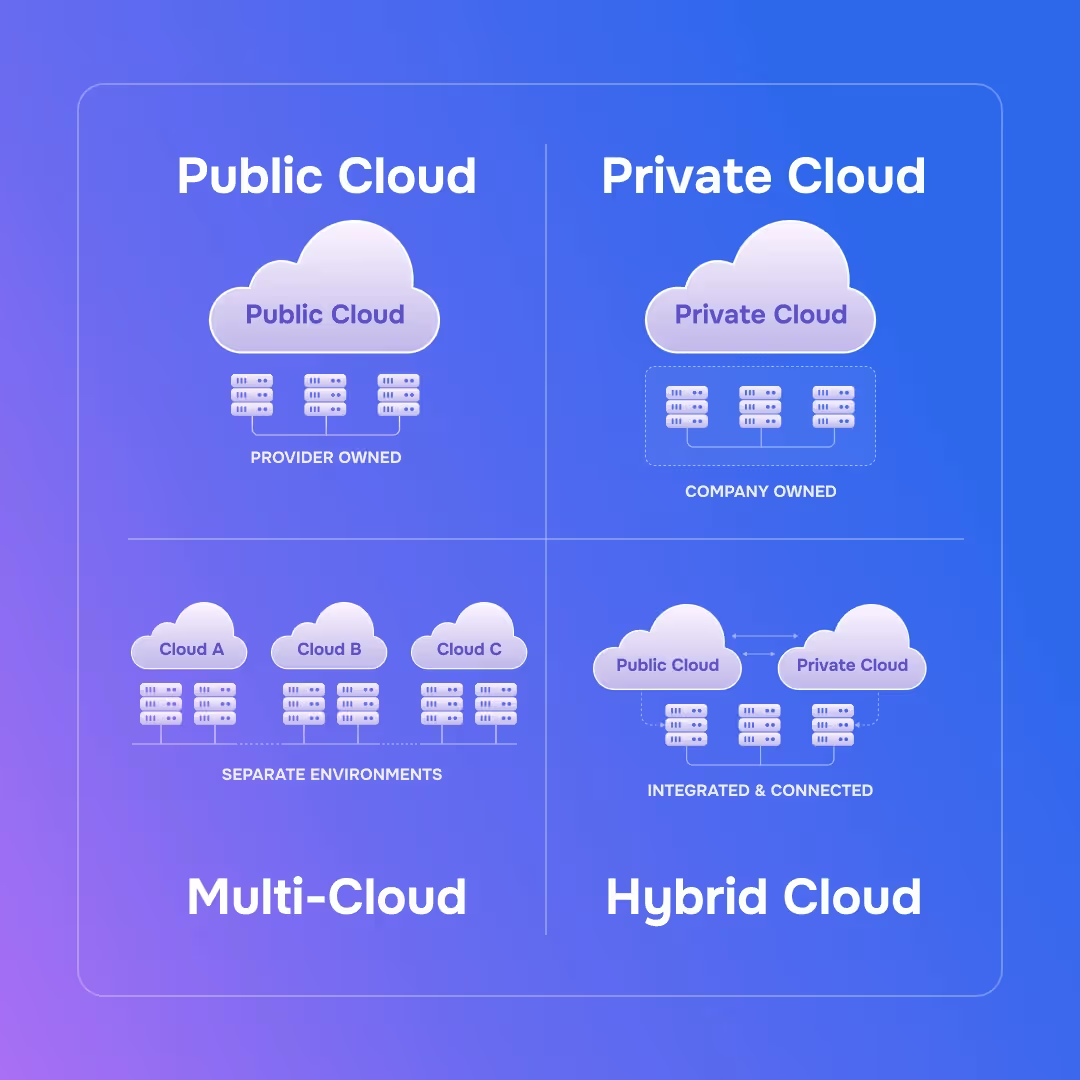
Hybrid cloud is a computing model that combines private infrastructure with one or more public cloud services, allowing organizations to run workloads across environments while managing them as a single system.
Unlike simply “using multiple clouds,” hybrid cloud emphasizes integration, management, and control. It’s not enough to have private and public environments — you need connectivity, consistent security, and unified governance to truly call it hybrid.
In one sentence: A hybrid cloud lets organizations operate private and public cloud environments together as a unified, flexible, and secure system.
Hybrid cloud works by connecting different environments in a way that makes them feel like one. Think of it as private servers and public cloud platforms, all connected with a bridge. That bridge is essentially network connections and management tools controlling how workloads move, where data resides, and how security is enforced. But that’s overly simplifying it.
In reality, there are several layers that make this possible:
By layering these systems, hybrid cloud allows organizations to move workloads where they make the most sense, whether that’s for cost, performance, or compliance reasons.
Here’s how it compares to other cloud computing models:
Hybrid cloud combines the best of private and public clouds. Private and public clouds work together as one system, with integrated management, consistent security, and the ability to move workloads where they make the most sense.
Organizations adopt hybrid cloud to balance flexibility, control, and efficiency. Often, it’s a strategy that allows them to modernize gradually and move to the cloud without sacrificing control.
Common drivers and use cases include:
Hybrid cloud helps organizations run smarter, safer, and more efficiently. It offers:
When implemented with proper governance and monitoring, hybrid cloud doesn’t just combine clouds, it turns them into a unified, more efficient, and more resilient system.
No solution is without trade-offs. Hybrid cloud introduces new layers of complexity that organizations must manage carefully:
Operational Complexity
Running and maintaining multiple environments increases operational overhead, especially when tooling, processes, and visibility are not integrated.
Security and Policy Consistency
Ensuring security controls, access policies, and compliance rules are applied consistently across on-prem, private, and public clouds can be difficult.
Networking and Latency
Connecting environments reliably and moving workloads or data between them can introduce latency, performance trade-offs, or unexpected networking costs.
Cost Visibility and Control
With spend spread across providers and environments, fragmented billing and limited cross-environment insight can make forecasting, optimization, and accountability harder.
Tool Sprawl and Skills Gaps
Even though hybrid cloud is meant to be integrated, teams often end up managing multiple cloud-native tools and skill sets.
These challenges are real, but they’re not blockers. With centralized management, automation, and governance, hybrid cloud can be operated as a single, cohesive system rather than a collection of disconnected environments.
Effective hybrid cloud is all about operating them as one system. That requires both centralized management and reliable connectivity across private, sovereign, and public clouds.
Key capabilities include:
Regulations like GDPR, DORA, NIS2, and sector-specific compliance frameworks require organizations to know where their data lives, who can access it, and under which jurisdiction it operates. Hybrid cloud gives jurisdictional control where it’s required, without giving up the scale and innovation of public cloud.
For many organizations and the public sector, sovereignty isn’t just about data residency. It’s about operational control, governance, auditability, and independence. They require:
EU-based providers like IONOS, Gcore, and OVHcloud check all these boxes, but many organizations need hyperscalers for scale, services, and global reach.
Hybrid cloud allows you to:
With the right management layer, sovereignty can become precise and intentional, not an all-or-nothing compromise.
The emma platform allows organizations to operate private and public clouds as one unified system.
Key capabilities include:
Hybrid cloud is ideal if your organization:
It may not be necessary for organizations that are fully cloud-native and have minimal compliance or regulatory constraints.
As organizations expand into edge environments, and scale AI-driven workloads, a single-cloud approach no longer holds up. Different workloads have different requirements for latency, cost, compliance, performance, and availability, and hybrid cloud is how those trade-offs are managed in practice.
Especially for AI workloads, training demands large, centralized compute capacity, while inference needs to run closer to users for low latency and efficiency. At the same time, GPU shortages, regional capacity limits, and hyperscaler waitlists make it risky to depend on a single provider for critical AI infrastructure.
Sovereignty is another forcing function. Regulations are tightening, especially in regions like the EU, pushing organizations to maintain clear jurisdictional control over data and operations. But they must do it without slowing innovation or locking themselves into provider-specific sovereign offerings.
In this backdrop, hybrid cloud is precisely how organizations are staying fast, compliant, and future-ready.