GPU VMs and GPU-enabled managed Kubernetes. One governance model.
GPU VMs across five providers. GPU-enabled managed Kubernetes across three hyperscalers. Pre-validated NVIDIA/CUDA images. Your data scientists self-serve. Your governance model covers everything they provision.


.svg)

GPU Virtual Machines
- •GPU configurations across AWS, GCP, Azure, emma, and Nebius
- •Pre-validated NVIDIA driver-optimized ML/DL images
- •Standard VM lifecycle: create, delete, start, stop
- •Same governance, cost view, and interface as all other emma VMs
GPU managed Kubernetes
- •Managed GPU K8s clusters across AWS, Azure, and GCP
- •Pre-validated CUDA container images — no driver conflicts
- •Provision via UI or CLI in under 5 minutes
- •Centralized cost and utilization dashboards per project/team
Before emma
- ✕Data scientists wait days for GPU VMs or clusters
- ✕Driver conflicts endemic
- ✕Different workflow per cloud
- ✕GPU resources outside governance perimeter
- ✕Cost siloed per provider. No unified inventory
After emma
- ✓GPU VM or K8s cluster in minutes
- ✓Pre-validated images — no driver debugging
- ✓Governance applied automatically
- ✓Self-service within guardrails
- ✓Unified cost per team, project, cloud
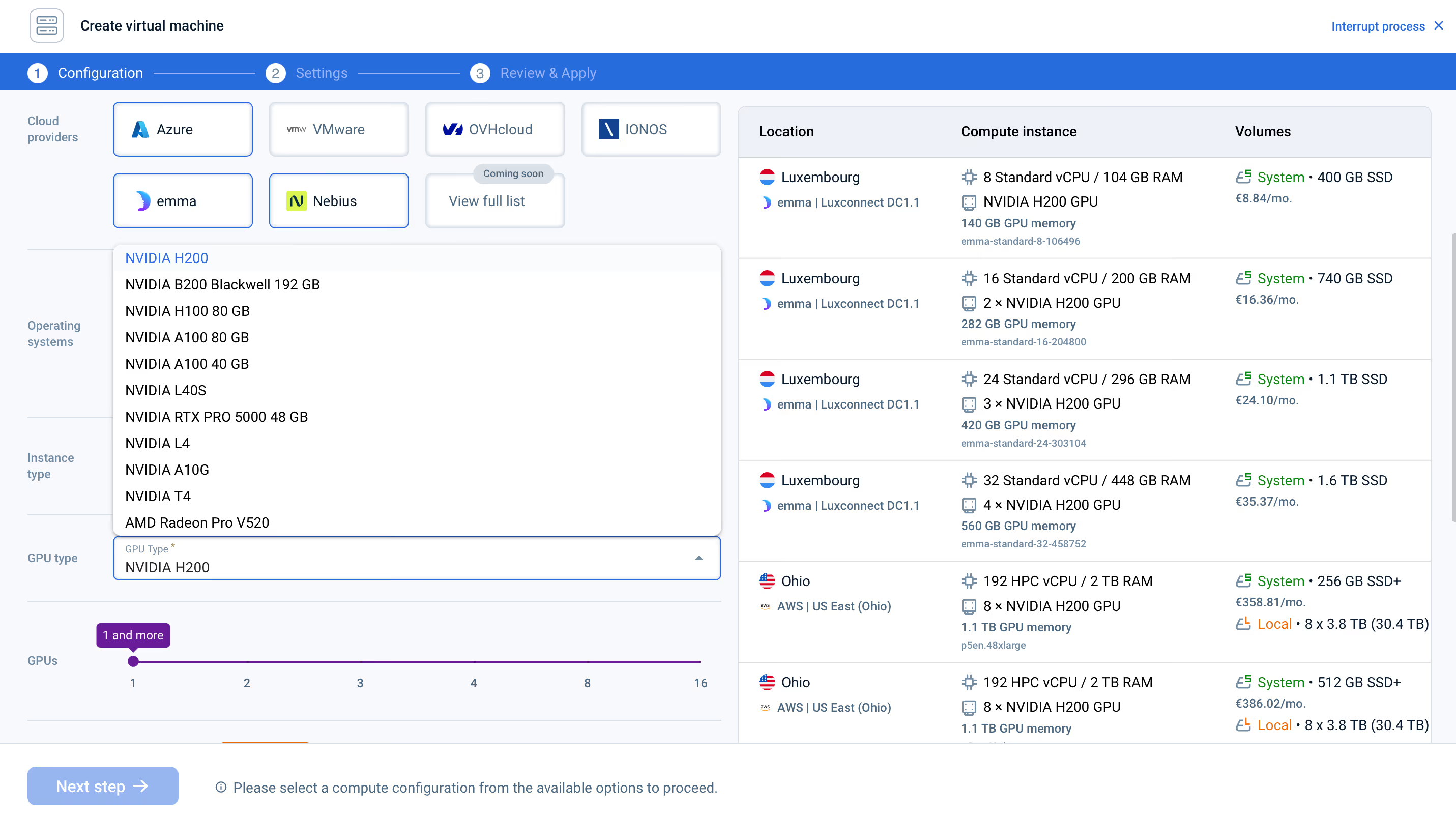
emma surfaces GPU availability, pricing, and instance types across all connected providers. Your team compares options, provisions from the best source, and governs everything through one interface — instead of navigating five provider consoles to find the right GPU.
Cross-provider comparison
Compare GPU instance types, availability, and pricing across AWS, GCP, Azure, emma, and Nebius before provisioning.
Spot and on-demand
Surface spot GPU capacity across providers. When spot dries up on one provider, find the next option — without leaving the platform.
Unified cost attribution
GPU spend attributed per team, project, and provider. One cost view regardless of where the GPU workload runs.
Access the latest NVIDIA and AMD accelerators through emma's unified platform.
Both are governed by the same platform. The choice depends on how you're operating today. If you already run workloads on Kubernetes, add GPUs to your existing environment with emma's Managed Kubernetes. If not, start directly with GPU VMs.
| GPU VMs | GPU managed Kubernetes | |
|---|---|---|
| Best for | Training runs, experimentation, full-stack control | Containerized workloads, orchestration, team scaling |
| Abstraction level | You manage the VM — OS, packages, runtime | Cluster is managed — you deploy containers |
| Providers | AWS, GCP, Azure, emma, Nebius | AWS (EKS), Azure (AKS), GCP (GKE) (3) |
| Provisioning speed | Minutes (VM wizard or API) | Under 5 minutes (UI or CLI) |
| Images | Pre-validated NVIDIA driver-optimized OS | Pre-validated CUDA container images |
| Monitoring | 3 GPU metrics (utilization, vRAM) | 9 GPU metrics (incl. power, temp, clock) |
| Inference workflows | Yes — governed templates deploy to VMs | On the roadmap |
| Governance | Same RBAC, tagging, cost, audit | Same RBAC, tagging, cost, audit |
Not sure? Both are available on the same platform. Many teams use VMs for experimentation and training, mk8s for production inference. emma's governance model covers both.
Model training and fine-tuning
Fine-tune foundation models or train custom models on H200, H100, or A100 GPUs. Pre-validated images mean your training job starts on first boot. VMs for full control, mk8s for orchestrated multi-node runs.
Real-time inference
Serve predictions in production on cost-effective GPUs (L40S, L4, T4). Deploy via Inference Workflow templates for governed, repeatable endpoints — or run serving containers on mk8s for Kubernetes-native inference.
GPU-accelerated data processing
Run RAPIDS, Spark on GPU, or custom ETL pipelines. Spin up GPU VMs for the job, shut them down when complete. Cost attributed per team and project — no surprise bills.
AI/ML experimentation
Data science teams self-serve GPU VMs within governance guardrails. Experiment freely without creating shadow infrastructure, ungoverned cloud spend, or driver-debugging tickets.
Provisioning a GPU is the start. What makes emma different is what happens after — monitoring, networking, deployment, and governance applied to every GPU resource from the moment it boots.
GPU monitoring
Utilization, vRAM, power, temperature — visible in the same interface as CPU and network. No agents. No third-party tools. Available for both VMs and mk8s clusters.
Cross-Cloud Networking
Training data on one provider, inference on another — connected through emma's 400 Gbps backbone. No VPC peering. No manual config. Up to 70% egress reduction.
Inference workflows
Governed templates for deploying inference environments on GPU VMs. Platform teams define the standard. Application teams self-serve. Every deployment is governed and auditable.
Should I use GPU VMs or GPU managed Kubernetes?
It generally depends on your current setup and how you run workloads. GPU VMs give you full control — ideal for training runs, experimentation, and workloads where you manage the full stack. GPU mk8s is better for containerized workloads that need orchestration and cluster-level management. Both are governed by the same platform. Many teams use both.
Which GPU types are available?
NVIDIA H200, H100, A100, L40S, L4, A10G, T4, and AMD Radeon Pro V520. Availability and pricing vary by provider and region.
Can I provision GPU resources via API?
Yes. Both GPU VMs and mk8s clusters can be provisioned via the emma API or the GUI. The same API works across all providers — no provider-specific SDKs required.
Do I need to install NVIDIA drivers?
No. GPU VMs launch with pre-validated, NVIDIA driver-optimized OS images. mk8s clusters use pre-validated CUDA container images. Your team gets a working GPU environment from first boot — no driver debugging.
How does cost attribution work?
GPU spend is attributed per team, project, and provider from the moment of provisioning. One dashboard for all GPU compute — VMs and mk8s — regardless of which cloud the workload runs on.
Is GPU autoscaling available?
GPU node autoscaling for mk8s is not included in the current release. You configure node count at cluster creation. Autoscaling is on the roadmap.
Can I connect GPU workloads across providers?
Yes. GPU VMs and mk8s clusters connect to workloads across providers through emma's 400 Gbps networking backbone. Training on one cloud, inference on another — connected architecturally. Learn more →
What monitoring is available for GPU resources?
GPU VMs: 3 metrics (utilization, vRAM usage, vRAM utilization). mk8s clusters: 9 metrics including power, temperature, and clock speed. No agents required. Learn more →
See GPU provisioning across providers from a single control plane.
45-minute walkthrough. VMs and managed K8s. Infrastructure, running.
Get a demo →