Production-ready managed infra
Continuous cloud optimization
Hybrid & multi-cloud networking
Security & compliance polices
AWS, Azure, Google Cloud, and more
IaC Terraform multi-cloud plugin
DevOps, CI/CD, analytics, and more
Lambda, S3, Blob, AKS, and more
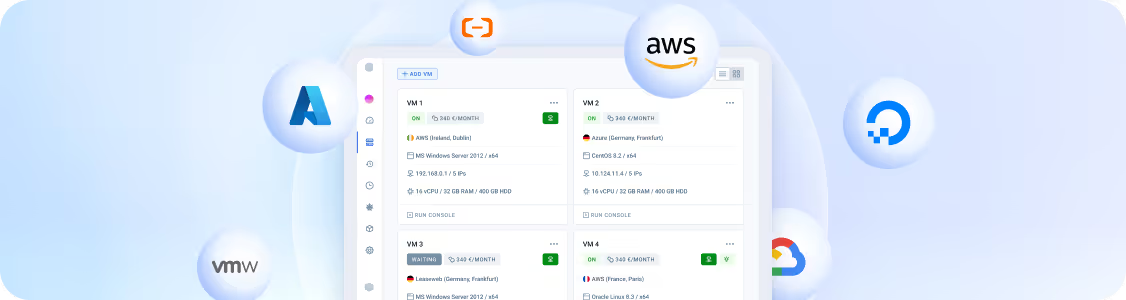
Provision & manage VMs on any cloud
Low-cost and fault-tolerant workloads
Deploy & run clusters on any cloud
Improved cloud resource efficiency
Boost performance with cloud-native
Overcome legacy & tech challenges
Deliver cloud solutions to customers
Migrate data, apps, and workloads
Stay informed with our latest articles
Industry research and white papers
Upcoming events, talks and summits
Technical docs, SDK, API, and tutorials
One of the biggest benefits of cloud computing and a “cloud-first” strategy is the potential for cost savings.
A multi-cloud strategy can generate numerous benefits for organizations. But on the flip side, it can also create challenges around cloud management and governance.
Recent CIF research suggested that hybrid cloud is very well established across organisations and is no longer the new paradigm.
Organizations seek performance optimization and cost-efficiency while managing their cloud workloads.
Cloud computing, slated to be a nearly $600 billion industry by the end of this year by Gartner, is one sector that has remained unaffected by the global slowdown due to the changing macroeconomic headwinds.
Migrating to the cloud requires a full feasibility assessment. See how to evaluate your cloud migration feasibility and make informed decisions.
Visibility in a multi-cloud environment refers to the ability to monitor and gain insights into the various components, resources, and activities across different cloud platforms that are part of the multi-cloud setup.
With ever-increasing data volumes, security concerns, customer expectations, and digitalization, organizations are rapidly transitioning to the cloud to reduce overheads and streamline operations.
Explore the complexities of cloud optimization and the unique challenges it presents. Learn why solutions like the emma platform are essential for a future-proof multi-cloud strategy.
Digital sovereignty has become a common topic in technology and regulatory circles today as companies try to gain control over their data and applications amid rising concerns about data privacy, cyber-attack risks, and varying laws across diverse geographies.
The digital space is witnessing emerging technologies and potential disruption. Lack of visibility in transformation can impair decision-making in the digital transformation space. Multi-cloud strategies can accelerate Digital Transformation.
Multi-cloud adoption is a new norm, especially among enterprise organizations.
A cloud agnostic multi-cloud strategy minimizes dependencies on any specific cloud platform.
Organizations can transform their cost optimization practices, achieve greater efficiency in their cloud operations, and maximize their cost savings.
Vendor-agnostic multi-cloud approach empowers organizations to harness the full potential of hyperautomation
See how the emma platform empowers organizations with the tools and insights needed to assess on-premises vs. cloud costs effectively, facilitating informed decision-making.
Many organizations face a common challenge: fragmented views of cloud costs across different providers and services.
As technology advances and AI models become more complex and require even more computational power, there may be ongoing challenges in keeping up with the demand for cloud resources.