Data Sovereignty vs Data Residency: What Businesses Need to Know
Understanding Data Sovereignty vs. Data Residency in Cloud
Amid rising geopolitical tensions, 82% of organizations are refining their cloud strategy to safeguard data sovereignty and maintain digital independence. As data laws become increasingly strict and companies shift more workloads to cloud infrastructure, knowing where data lives has become essential.
Understanding which laws apply has become a strategic requirement. Terms like data residency and data sovereignty are now central to compliance, privacy, and risk management, especially in multi-cloud environments.
While these terms are often used together, each has different challenges and imposes specific obligations on organizations operating across borders or in regulated industries. This guide explains both concepts, clarifies how they differ, and explores why those differences matter in practice.
What Is Data Residency?
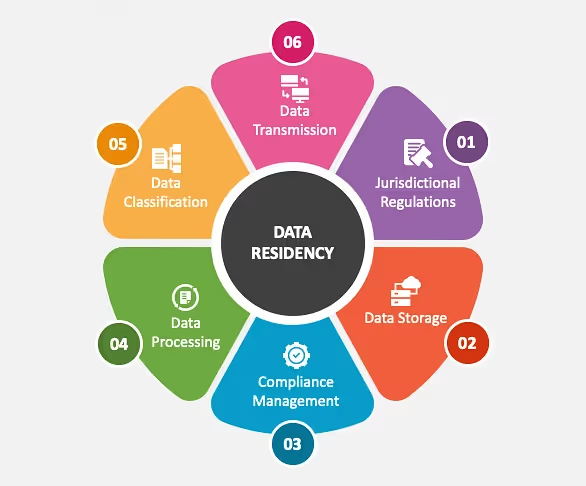
Data residency refers to the country or region where an organization’s data is stored and processed, determined by the physical location of the data centers or infrastructure hosting it.
The main considerations around data residency include:
Meeting local regulations or contractual obligations requiring certain data to remain within a specific geography, such as keeping EU citizens’ data within the European Union (EU).
Improving performance for users located in the same region as the data to reduce latency and improve application response times.
Addressing customer expectations around having their data stored locally, which can improve trust and satisfy regional market requirements.
For instance, a company serving EU customers may choose to store its data in Frankfurt or Paris to comply with European laws and reduce response times. It requires reducing architectural complexity by minimizing cross-region data transfers and consolidating infrastructure components within a single geography.
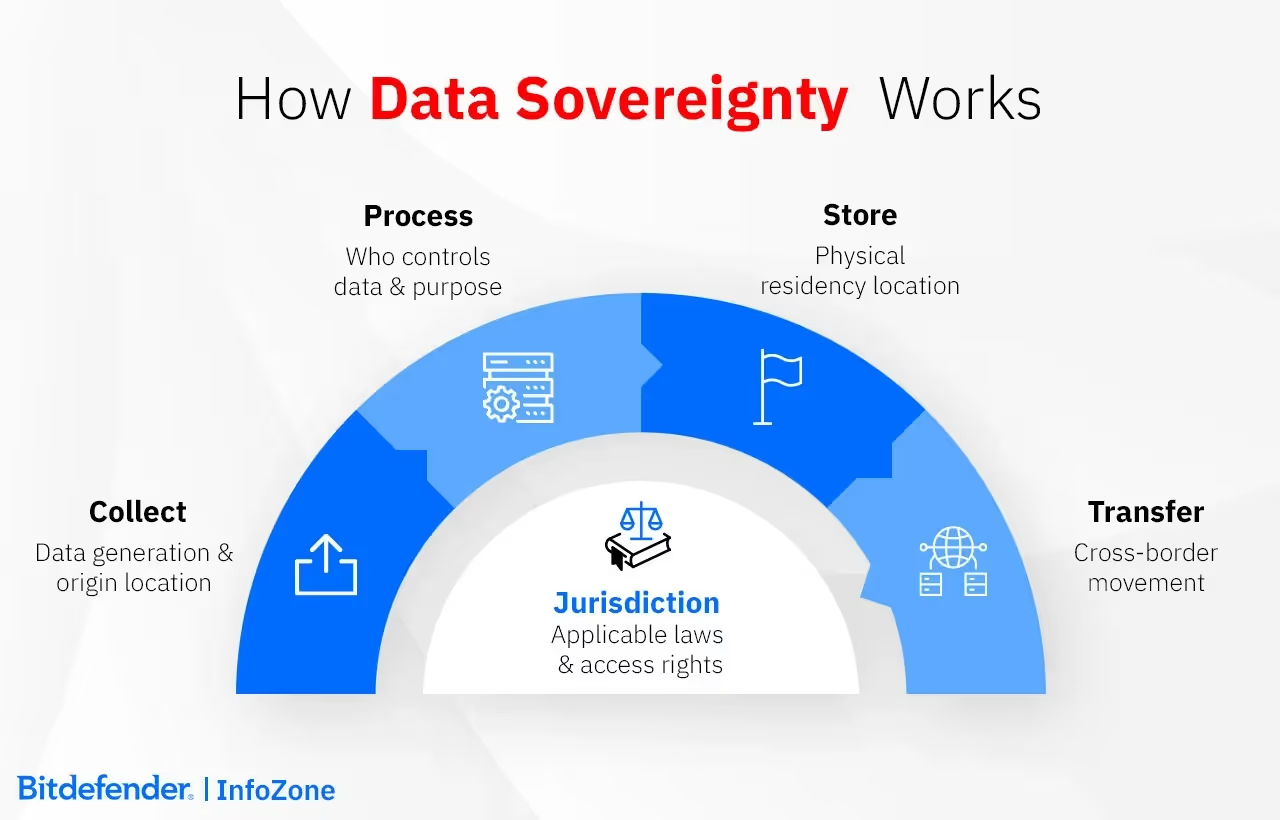
Data sovereignty refers to the legal ownership and governance of data. When data is stored or processed in a particular jurisdiction, that jurisdiction’s laws and regulatory bodies can assert rights over the data and the infrastructure or services that handle it.
But this can create challenges in a global cloud environment, where data may physically reside in one region while being controlled or managed by a provider subject to another country’s laws. For example, the U.S. CLOUD Act law allows American authorities to demand access to data from U.S.-based cloud providers, even when that data is stored in the EU.
A 2025 Forbes investigation revealed that Microsoft admitted to the French Senate that it cannot protect EU data from U.S. government demands due to these legal obligations, even though the data resides in EU servers. This creates a potential conflict between data residency requirements (data physically in the EU) and data sovereignty concerns (control and legal authority over that data).
Key aspects of data sovereignty include:
How privacy and data protection rules apply to the data, including obligations around consent, purpose limitation, and user rights.
Government or law enforcement access rights.
Limits on how data can be processed, shared, or transferred across borders, and the need for legal mechanisms.
Restrictions on foreign control or influence over infrastructure, operations, and support staff that could gain access to the data.
At first glance, data residency and data sovereignty appear closely related, but treating them as interchangeable can expose organizations to legal and compliance risks. Understanding how each concept operates is critical for designing cloud strategies that hold up across jurisdictions and regulatory regimes.
Dimension
Data Residency
Data Sovereignty
Core Objective
Ensures data is physically stored within a defined geographic location
Ensures data is subject to and protected by the laws of a specific jurisdiction
Primary Concern
Physical location of data storage
Legal authority, control, and jurisdiction over data
Scope of Control
Storage location only
Entire data lifecycle: creation, processing, storage, transfer, access, and deletion
Compliance Focus
Location-based mandates or sector rules that require in-region storage (e.g., EU financial or public-sector hosting requirements)
Jurisdictional laws governing lawful access and control (e.g., GDPR applicability, U.S. CLOUD Act)
Risk Addressed
Latency, performance, and basic regulatory compliance
Foreign government access, cross-border legal conflicts, and loss of jurisdictional control
Typical Use Cases
Regional hosting mandates, data localization rules
Regulated industries, government data, critical infrastructure, sensitive IP
Strategic Question
Where should data be stored?
Which legal system governs the data, and who can compel access?
Cloud Design Implication
Selecting cloud regions and storage locations
Choosing providers, ownership structures, encryption models, and operational controls
Even when data is stored locally, foreign sovereignty can still apply. In the EU, GDPR also regulates how personal data of EU residents is processed. This makes it both a sovereignty-focused regulation and a residency law. In the US, the CLOUD Act allows authorities to compel US-based cloud providers to disclose data under their control, even if the data is stored outside the United States.
To effectively manage these risks, organizations must carefully choose cloud providers that align with both their data location needs and the legal jurisdictions they must comply with.
Why the Difference Matters
Understanding the difference between data residency and data sovereignty helps organizations effectively manage risk and protect sensitive information. It also reduces costly mistakes and supports compliance across hybrid and multi-cloud environments.
Modern regulations expect organizations to:
Store data only in approved locations.
Ensure data is subject to the correct jurisdictional rules.
Reduce risks when transferring data across borders.
Keep backups, replicas, and failover systems compliant with local laws.
Prevent cloud providers from accessing data in ways that break sovereignty rules.
This gets even more complicated in a multi-cloud setup. Different providers have their own region structures, naming systems, replication methods, and legal frameworks. Without careful oversight, data can easily end up outside compliant zones, even unintentionally.
Failing to manage both residency and sovereignty can lead to serious issues:
Regulatory fines or penalties under laws like GDPR, where serious violations can lead to fines of up to €20 million or 4% of global annual turnover, whichever is higher.
Breach of contractual obligations with customers, partners, or regulators by failing to keep data in the promised region or under the required sovereignty rules.
Unintended exposure to foreign government access, especially if data is hosted by providers subject to extraterritorial laws.
Loss of customer or partner trust if data handling practices appear opaque or risky.
Security and compliance drift as multi-cloud deployments grow and become harder to track.
Understanding Sovereign Cloud
To address these issues, organizations can turn to sovereign cloud solutions to have tighter control over residency and access. Sovereign cloud refers to cloud infrastructure, services, and operational controls governed by the laws of a specific country or region.
It includes who operates the cloud, which regulators have authority, and whether foreign governments can compel access. This matters for the public sector, healthcare, finance, and other regulated industries.
Sovereignty Approaches by Cloud Providers
Different cloud providers combine technical, legal, and operational measures to support sovereignty and residency:
Key Mechanisms
Data residency controls: Pin data and workloads to specific regions or countries to avoid storage or processing in non‑approved jurisdictions.
Jurisdictional and legal safeguards: Use local entities and contracts to clarify which courts and regulators can exercise authority and to reduce exposure to extra‑territorial laws.
Operational and access controls: Rely on in‑region staff, strong identity and access management, and auditing to prove who can access data and under what conditions.
Major Regulations and Frameworks Supported
GDPR: Governs personal data processing and cross‑border transfers across the EU/EEA. Providers must offer appropriate contracts, regional processing options, and transfer mechanisms.
EU/national localization and sector rules: Some financial, health, and public‑sector workloads must remain in‑country or within the EU, leading providers to offer in‑country or sovereign-region options.
Security and sovereignty schemes: Frameworks such as SecNumCloud, BSI C5, and ISO 27001 help demonstrate that infrastructure and operations meet national or sector requirements.
Types of Sovereign Cloud Models
Cloud providers differ significantly in how they handle sovereignty and residency. Broadly, there are three models for designing sovereignty, including global hyperscalers, EU-based, and local sovereign cloud models.
Feature
Hyperscalers (Global)
EU-Local Sovereign
Local / National Sovereign
Cloud Providers
Amazon Web Services (AWS), Azure, or Google Cloud Platform (GCP)
IONOS, OVHcloud, and Gcore
Country telecom or government‑backed clouds
Global Presence
Many regions worldwide
EU only
Country-only
Sovereignty Posture
Strong tech controls, but home‑country laws still apply
Infrastructure and operations under EU jurisdiction
Data, staff, and operations kept under national jurisdiction
Service Depth
Very broad services and fast innovation
Narrower catalog, focused on core infra and compliance
Core IaaS/networking; slower feature expansion
Compliance Focus
Global standards (ISO, SOC, general GDPR tooling)
EU frameworks and sector certifications
National regulations and local supervisory expectations
Typical Use Case
Global apps with moderate sovereignty needs
EU regulated and public‑sector workloads
Highly sensitive national workloads (defense, critical infra, etc.)
For instance, EU‑based providers such as IONOS, OVHcloud, and Gcore emphasize EU data protection, local control, and sovereign‑ready services for European and public‑sector workloads.
How to Choose the Right Provider
When selecting a sovereign cloud model or provider, focus on a few core factors:
Legal and Regulatory Compliance: Ensure the provider complies with the laws and regulations of the jurisdiction where you operate, including data protection, cybersecurity, and sector-specific mandates. For example, in the EU, this would include GDPR and NIS2.
Data Control and Residency: Verify that the provider has full control over where data is stored and processed, keeping it within the boundaries required by your jurisdiction. Mechanisms to enforce strict residency policies are essential.
Access Control and Security: Assess the provider’s security measures, including encryption, identity and access management, and audit capabilities. Only authorized parties under your jurisdiction should be able to access sensitive data.
Infrastructure and Supply Chain Independence: To possible extent, ensure the sovereign independence of the infrastructure—hardware, network, and software components—so that critical operations are not subject to foreign control or legal exposure.
Transparency and Auditability: Choose providers that offer full operational visibility, including logging, monitoring, and reporting, along with support for independent audits to verify compliance with your jurisdiction’s sovereignty requirements.
Interoperability and Portability: Ensure support for open standards, multi-cloud compatibility, and workload portability, so you can maintain sovereign control while avoiding vendor lock-in.
Practical Considerations for Organizations
To stay compliant and secure in a multi-cloud reality, organizations should:
Map data: Track where each dataset, backup, cache, and replica is stored, processed, and replicated across providers and regions.
Perform legal review: Work with legal and compliance teams to understand which jurisdictions might assert authority over different datasets.
Vet providers: Evaluate backup strategies, disaster recovery approaches, support models, and key management to ensure they align with residency and sovereignty needs.
Enforce controls: Implement technical controls and policies to prevent teams from accidentally deploying workloads to non-compliant regions.
Continuously monitor: Use monitoring and governance tools to detect and correct any configuration drift or unexpected cross-border data movement.
Align operations: Ensure that backup, failover, and support operations follow the same sovereignty strategy and production workloads.
How emma Supports Data Residency and Data Sovereignty
The emma platform is designed to simplify and automate aspects of data residency and sovereignty controls for organizations running hybrid or multi-cloud operations. It focuses on practical, policy-driven governance instead of one-off configurations.
Here is how emma helps you meet both residency and sovereignty requirements:
Granular location mapping offers a centralized view of your entire hybrid and multi-cloud footprint, making it easier to prove compliance during audits and respond to regulatory inquiries.
Pre-provisioning guardrails automatically block deployments into non-compliant regions to reduce human error in complex setups.
Data residency and sovereignty policies enforce where data can be stored, ensuring compliance with geographic regulations such as GDPR.
Organizations need to prioritize data sovereignty to maintain control over their operations and protect their data as regulations tighten globally. Fully understanding what sovereignty entails will be critical to navigating the next wave of compliance, security, and geopolitical challenges.

.avif)
.png)